Guide · Local SEO
Someone googles "joinery Aarau" and three businesses appear at the top of the map. Yours isn't one of them. Instead, the competitor from across the street waves back at you. You may have set up a Google listing at some point, but it doesn't seem to be doing much.
This kind of NAP data is decisive today.
It determines your ranking in Google Maps and decides whether ChatGPT and other AI search engines recommend your business at all. Whoever has inconsistent data loses both.
Three building blocks let you improve your Google Maps ranking, with no prior knowledge required.
What you'll learn here
About the Google Maps ranking
What is the Google Maps ranking?
The Google Maps ranking is the order in which Google sorts local businesses in map search and in local search results. The three results that appear at the top of the map for a search are called the Local Pack. Every business wants to be there.
Experts call this whole discipline Local SEO.
You can't buy these spots. Only those who maintain their Google Business Profile like a social media profile land there.
How Google sorts: relevance, distance, prominence
Google decides how local search results are displayed based on three ranking factors: relevance, distance and prominence.
You have no lever over distance: your location is your location. Relevance and prominence, on the other hand, you do.
| Factor | Can you influence it? | Your lever |
|---|---|---|
| Relevance | Yes | Complete profile, correct category, up-to-date content |
| Distance | No | None, your location is fixed |
| Prominence | Yes | Reviews, consistent listings across many platforms |
The same data counts in AI search
Your profile data no longer just decides your Maps ranking today. ChatGPT, Perplexity and Google's AI answer questions like "who does X in Y" from the very same structured sources: your Google Maps listings, directories and profile data.
One example is Bing Places. For a long time it was a sideshow. Today ChatGPT's web search runs on it. Whoever is missing there, or listed with wrong data, simply doesn't exist for AI search.
The consistency of the data is also decisive.
If your address is spelled differently across three platforms, the AI can't be sure it's the same business. So it names the competitor with the clean data instead.
What a better ranking gets you
A better ranking in Google Maps gets you more calls, more direction requests and more website clicks, all directly measurable in your profile statistics. That puts you in front of potential customers with concrete intent: whoever searches for "physiotherapy near me" wants an appointment.
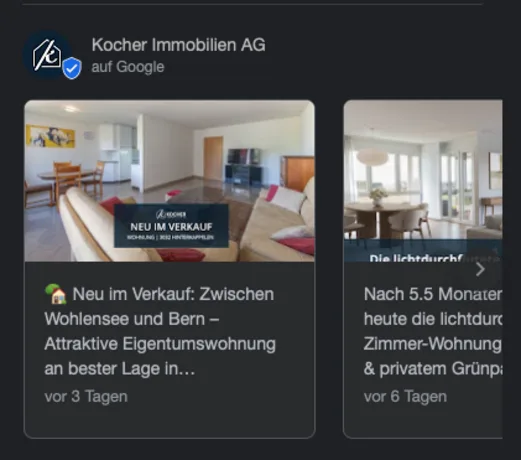
What that looks like in practice is shown by Kocher Immobilien in Bern. The company publishes posts via smt-LISTINGS on its profile every few days and ranks second for property searches in Bern, despite very high competition.
Before you optimise: the Data Check
Before you change anything on your profile, check what already exists. Which listings for your business exist? Where do they differ from one another? And is an old, orphaned profile haunting things somewhere?
Duplicates are two profiles of the same business sharing reviews and all signals. Both stay weak, and you don't even notice.
From our Data Checks, we know the five most common mistakes:
- Inconsistent basic data: name, address and phone number differ: sometimes with Ltd/GmbH, sometimes without; sometimes "Street", sometimes "St."; sometimes landline, sometimes mobile
- Different or wrong categories across platforms
- Inconsistent logo or company name depending on the platform
- Duplicates: orphaned profiles that no one maintains any more
- Outdated opening hours: especially around cantonal public holidays
Every one of these mistakes costs you twice over. Google trusts your data less and shows the competitor with clean listings further up.
Our free Data Check finds exactly these mistakes for you.
Building block 1: The foundation
The foundation means: your basic data is correct and identical everywhere.
First, you create and verify your Google Business Profile. Only after that do you have full control over your listing.
Then the categories. These are an often overlooked lever. The primary category is one of the strongest ranking factors there is. Choose it as precisely as possible: "Joinery" beats "Service provider" by a mile.
Next, check your NAP data. NAP stands for Name, Address, Phone number. These three details must be written exactly the same everywhere. The benchmark for this is your commercial register entry, the Zefix company name.
The foundation also includes your opening hours, including cantonal public holidays. Almost nobody in Switzerland keeps this up to date: Sechseläuten in Zurich, Fasnacht in Basel, Jeûne genevois in Geneva.
Google knows these days and displays your listing correctly once you've maintained the data.
Building block 2: The momentum
Momentum means: your profile constantly shows Google that your business is alive. Publish posts regularly and upload new photos and videos. Do you have a shop or premises? Then a 360-degree tour is worth it. Treat your profile like a social media channel, with a clear call to action in every post.
With Google reviews, more than the sheer number counts.
Collect them actively and respond to them consistently, because the response rate is the signal almost everyone forgets.
Ask satisfied customers directly after the job, in person or by email. And stay calm and professional even with negative reviews: every future customer reads your reply too.
Important: buying reviews doesn't pay off. Google detects purchased reviews, and in Switzerland this is also relevant under unfair competition law (UWG), so legally risky.
Also use your profile's Questions & Answers feature (Q&A). Post the most common customer questions yourself and answer them. That way you control the answers before someone else does.
Building block 3: External confirmation
The third building block turns your data into proof of trust. The same details appear on many platforms, identically everywhere. For Google, that's proof that your business is real and active.
Apple Maps and Bing Places are mandatory here.
iPhone penetration in Switzerland is high. Whoever is missing on Apple Maps is missing from many car dashboards and many pockets. And Bing feeds ChatGPT's web search: your Bing listing is your ticket into AI answers.
For directories, a clear three-tier structure applies:
| Tier | What | Examples |
|---|---|---|
| Reference | Benchmark for the company name | Zefix (commercial register) |
| Tier 1: Mandatory | For every business | Google Business Profile, Apple Maps/Business Connect, Bing Places, Facebook/Instagram Places |
| Tier 2: Depending on industry | Where your customers search | HERE, TomTom (car sat-navs), Waze, Yelp, business databases, industry portals |
| Tier 3: Save your effort | Doesn't achieve anything | Pure link directories, paid premium listings on minor portals |
Ten identical listings beat fifty contradictory ones. That's the benchmark for this building block, measured against your Zefix company name.
External confirmation also includes your website.
Have the so-called LocalBusiness markup added there. This is a small data package in the code that delivers your company data to Google in a machine-readable format. Whoever looks after your website can do this in minutes.
In addition, keep the NAP data identical in the footer and, if you have several locations, set up dedicated location pages. That way your own website confirms what all the directories say.
Watch out for directory scams: Do you receive an "invoice" or a "listing offer" by post or email from a directory you don't know? Don't pay, don't sign. Such offers are often deceptively presented and relevant under Swiss unfair competition law (UWG). Reputable providers don't send you post that looks like an invoice.
Why can't my business be found on Google Maps?
If your business can't be found on Google Maps, it's almost always down to one of these five points, each with an immediate fix:
- Profile not verified: complete verification, since Google barely shows your listing beforehand.
- Wrong or missing primary category: set the category precisely; it's one of the strongest levers.
- Contradictory NAP data: align all listings with your Zefix company name: name, address, phone number the same everywhere.
- Duplicates: find orphaned secondary profiles and have them merged with the main profile.
- Dead profile: no post, no photo, no answered review for months? Then momentum is missing. Start with building block 2.
If you can't find the problem yourself, our Data Check shows you in black and white where things are stuck.
By hand or with software?
Everything described above can be done by hand.
Initial set-up across all relevant platforms costs you 8 to 15 hours per location. After that, another 3 to 6 hours per month and location keep coming, spread across more than 50 logins. The biggest time sink is repetition: a new phone number means logging in, changing it and saving fifty times over.
Centralised via smt-LISTINGS, the maths looks different. You maintain a single source of truth, and a change lands automatically via direct connections to the platforms on 40 to 50+ portals, within 5 minutes to 24 hours depending on the platform. Contradictions simply can't happen any more.
What's left for you is the content side: 30 to 60 minutes per month for posts and reviews. And it all scales: ten locations mean one click instead of an afternoon.
How you can tell it's working
Whether your work is paying off, you can see directly in your profile's statistics: calls, direction requests and website clicks.
Also take a look at the ratio of discovery to direct searches.
Direct means: someone specifically searched for your business name.
Discovery means: someone searched for "industry + location" and found you.
This exact figure grows as your Maps ranking rises. Check the values once a month, then you'll spot the trend.
FAQ: Common questions about the Google Maps ranking
How can I improve my Google Maps ranking?
With three building blocks: foundation (correct data, identical everywhere, and the right category), momentum (posts, photos, reviews including replies) and external confirmation (identical listings on Apple Maps, Bing and in relevant directories). Beforehand, a Data Check is worthwhile to find mistakes and duplicates.
Why can't my business be found on Google Maps?
Usually due to one of these points: missing verification, wrong primary category, contradictory NAP data, duplicates, or a dead profile with no activity. Every point can be fixed. The diagnosis list above shows the immediate fix for each cause.
How long does it take for the ranking to improve?
You'll usually see initial movement 2 to 4 weeks after cleaning up your data. A stable effect takes 3 to 6 months. One business went from position 15 to position 4 in four weeks this way. In cities like Bern, Zurich or Basel it takes longer due to the competition; in smaller towns it goes faster.
What does a better Google Maps ranking cost?
Done by hand, it mainly costs time: 8 to 15 hours of initial set-up and 3 to 6 hours per month and location. With smt-LISTINGS, you choose between three packages: smt-DATA, smt-PRO and smt-ENTERPRISE.
What is the Local Pack?
The Local Pack is the three business results shown at the top with the map for a local search, above all other results. These spots can't be bought; they go to the profiles with the best signals for relevance and prominence.
Do more reviews automatically mean a better ranking?
No, the number alone isn't enough. Just as important is the response rate, i.e. whether you react to reviews. A profile with many unanswered reviews looks abandoned. Collect reviews continuously and answer every single one, including the critical ones.
Can I improve my ranking without my own website?
Yes. The foundation, momentum in the profile and consistent directory listings also work without a website. However, a website with LocalBusiness markup and identical NAP data in the footer further reinforces the signals, as external confirmation.
Is a listings tool worth it for a single location too?
Absolutely! By hand, a single location already takes 8 to 15 hours of initial set-up plus several hours of upkeep per month across 50+ logins. Managed centrally, a change is done in minutes, and only 30 to 60 minutes per month remain.
Start with the free Data Check
It's not the biggest player who wins, but the most active.
Visibility is data maintenance. Since AI search reads from the same sources as Google Maps, every well-maintained line pays off twice. The first step costs you nothing: our Data Check shows you where your listings stand today, where they contradict each other and which duplicates are holding you back.
Free Visibility Analysis
Where are you found – and where aren't you?
Tell us who you are. We'll check your business on Google, Maps, in AI searches and the most important directories, and get back to you within one business day with the results.
- Visibility on Google, Apple Maps, Bing, Siri & ChatGPT
- Missing, duplicate and incorrect listings
- Review check and comparison with the competition
- Free, no obligation, no access needed
Prefer to talk directly? +41 41 553 41 14 or Book a demo.